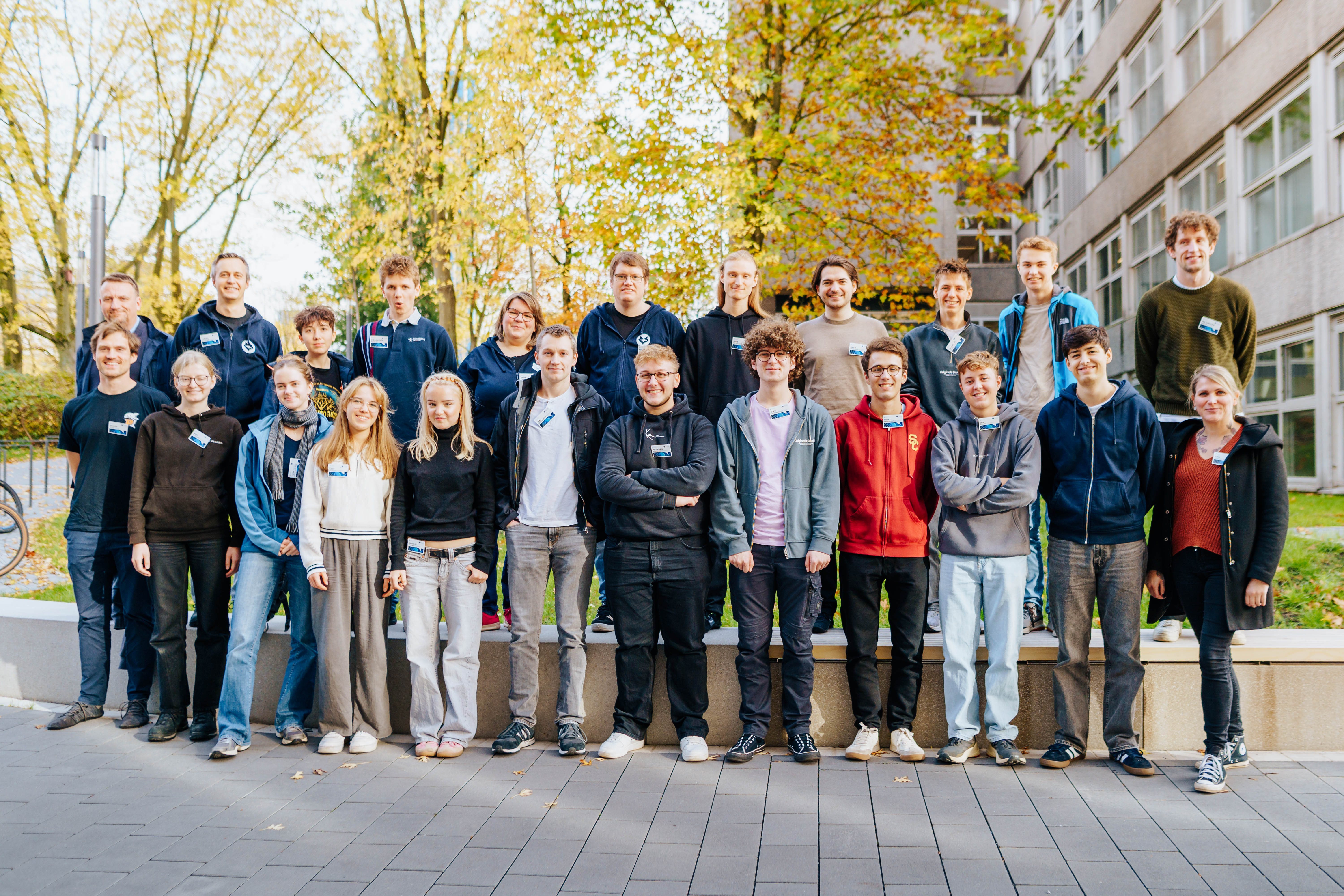
From 4 to 6 November, 15 particularly committed students from all over Germany met at the MINT-EC camp in Paderborn to experience real research up close for three days. The three-day research and experimentation workshop was organised jointly by Pelizaeus-Gymnasium Paderborn and the Institute for Photonic Quantum Systems (PhoQS) at Paderborn University, with the support of zdi.Paderborn. The participants won through against numerous applicants in the Germany-wide application process and showed not only outstanding professional interest, but also great commitment to STEM topics. The MINT-EC network, the national excellence initiative for STEM education, uses this and other programmes to support lighthouse schools in sustainably strengthening their role as talent incubators for scientific and technical talent.
Under the motto "Quantum systems - from light signals to quantum computers", the young participants were able to experience, explore and think about quantum physics, not just theory, in a workshop designed by Dr Anna Bauer. Under the guidance of PhoQS scientists, the basics of photonic quantum technologies were taught, from the light source and light waves to quantum materials and the first German demonstrator of a photonic quantum computer (PaQS).
From theory to the lab
The camp began at Pelizaeus-Gymnasium, where the students, together with teachers Carolin Eidhoff, Michael Dohmen, Maximilian Maiß, Marko Fischer and Dr Rainer Eckel, carried out their first experiments with beam splitters, photons, light waves and matter waves. On the second day, the journey led to research at the PhoQS: after a welcome from Prof. Dr. Christine Silberhorn, spokesperson for the PhoQS, the participants were given an insight into the world of quantum computers and a tour of the laboratories in the institute's new research building.
The highlight for the pupils was that they were allowed to conduct their own experiments in the laboratories and rooms of the university under the guidance of the researchers. Through the experiments, the students were able to get to know the PhoQS research spectrum at first hand, including experiments such as the 3D nanocharacterisation of quantum optical components or the development of quantum cryptography protocols, the analysis of photon statistics for different types of light, the production of surface structures in the clean room and the design of complex photonic chips.
"As always, it was impressive to see how quickly young people grow into the complex topics, from theory to practical implementation. They didn't just learn, they actively thought, researched and asked questions," says Prof. Dr. Silberhorn. "That shows: The future of quantum technologies will not only be created in laboratories, but also in the minds of young people. That's why we are all the more pleased about collaborations like this and others like it, because it is very important to us to support the promotion of young talent. "
Conclusion with presentation and perspectives
On the third day, the students presented their project results together with the scientists with enthusiasm, creativity and great commitment. The presentations not only showed what they had learnt, but also how deeply they had delved into the topics. In the evenings, they cooked together and took part in various activities, such as bowling. Not only did the students learn more about quantum technologies, they also made new friends.