Objectives of PhoQS - FUTURE
You as PhD candidate in the interdisciplinary PhoQS - FUTURE Graduate Program work in one of the research fields Physics, Electrical Engineering, Mathematics and Computer Science. You are closely supported on your path to your theses. Different courses, workshops and close supervision which complement each other give you the best possible support in your own development from day one.
The Graduate Program is based on three pillars:
1. Empowering excellent PhD candidates: Outstanding achievements by the PhD candidates are well recognized and rewarded.
2. Individual career development: from day one, PhDs are closely supported in their individual development by the dedicated PhoQS - FUTURE coordinator as a central contact person.
3. Support in acquiring academic skills: Tailor-made workshops and courses support the PhDs at all important milestones.
PhoQS-FUTURE Graduate Program
Programme overview
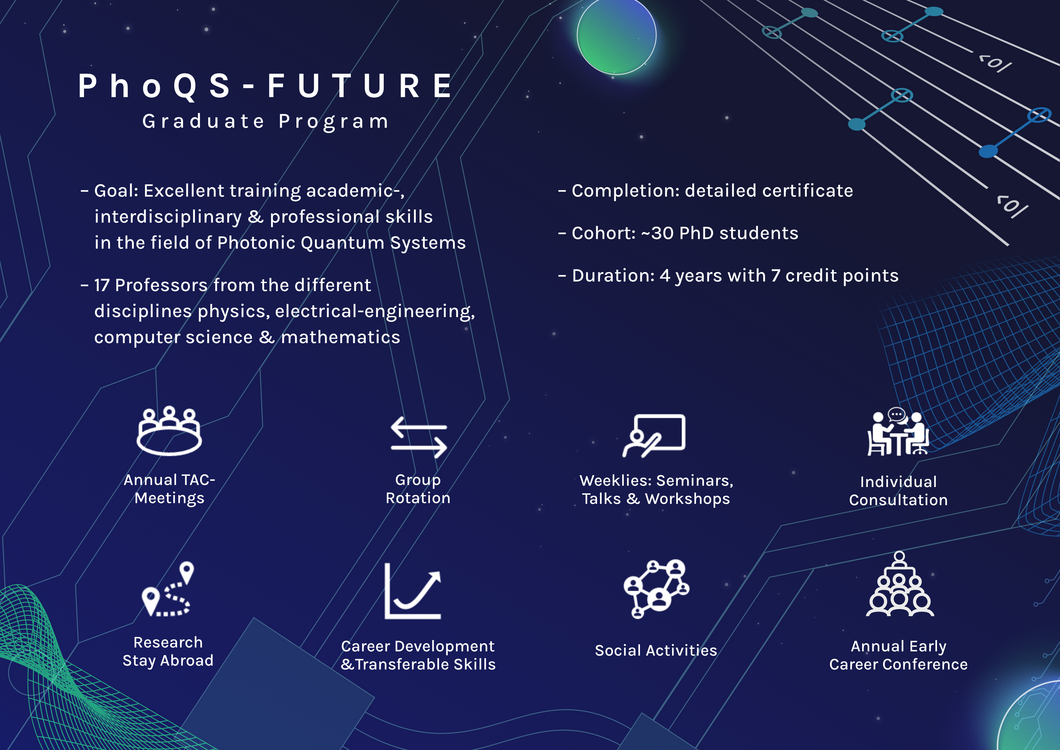
Since 2025, PhoQS has been developing the interdisciplinary PhoQS-FUTURE Graduate Program for targeting and excellent training of young researchers and doctoral students in the area of quantum photonics research. The program’s goal is to foster closer collaboration among the 17 professorships and their staff across the four disciplines through standardized training for doctoral students. The doctoral students receive excellent training in scientific, interdisciplinary, and professional skills to prepare them for an excellent career in academia or industry. The program modules that have been developed are precisely tailored to the needs of doctoral students and are designed to give them the opportunity to systematically develop additional academic and methodological skills, broaden their perspectives, and connect them with international researchers and companies.
The program is designed to last three till four years, comprises 30 credit points (comparable to the course load of the first semester of a bachelor's degree program), and concludes with a certificate.
The program’s modules include an intensive academic exchange among doctoral students from the four disciplines through weekly meetings, methodological training—such as workshops on the use of AI in data processing—and the development of interdisciplinary skills through targeted coaching sessions. In addition, supplementary training courses in areas such as good scientific practice and scientific writing are offered to help students acquire academic and professional skills. During the group rotations, doctoral students can get to know another research group, its areas of focus, and its methods.
One of the highlights of the program is the annual Early Career Conference. The program’s doctoral students organize this conference themselves, allowing them to tailor it as closely as possible to their needs and professional development.
A wide variety of social events—which other PhoQS members always enjoy attending—provide opportunities for networking and getting to know one another.
Supervision
Doctoral students in the PhoQS-FUTURE Graduate Program are supervised by two advisors from the PhoQS groups to ensure that the quality of supervision is enhanced by multiple disciplinary perspectives. In addition to the usual supervision meetings, mandatory TAC meetings (thesis advisory committee meetings) will be held once a year. The doctoral student may decide who, in addition to their two supervisors and the RTG coordinator, may participate in the meeting. Typically, postdocs or other professors whose perspectives are expected to greatly benefit the project are invited to attend. The doctoral student presents the committee with a summary of their work over the past year and their planned steps for the coming year. The advisors discuss the research findings with the doctoral candidate and provide feedback on the progress of the dissertation. In addition to ensuring the quality of supervision and strengthening the working relationship, this process supports the doctoral candidate in developing strategic research skills. The coordinator ensures the standardization of the quality of supervision, maintains an overview of the current status of the projects, and is subsequently able to provide doctoral students with much more informed guidance and advice as they pursue their doctorates. The coordinator held individual meetings with the doctoral students following the annual TAC meetings. As a neutral party who does not evaluate the students’ dissertations, the coordinator provides doctoral students with another person with whom they can confidently discuss the typical challenges they face during their doctoral studies.