Three research groups at the Institute for Photonic Quantum Systems and the Physics Departement of Paderborn University – Theory of Functional Photonic Structures (Prof. Dr Stefan Schumacher), Ultrafast Nanophotonics (Prof. Dr Thomas Zentgraf) and Theoretical Quantum Science (Prof. Dr Jan Sperling) – have made progress in the field of modern photonics in their latest work. In two publications, the researchers investigated how light can be precisely manipulated through targeted structuring and coupling at the nanoscale, operating at the interface between classical optics and topological physics.
In the first publication, researchers from the research groups led by Thomas Zentgraf and Stefan Schumacher, along with PhD students Helene Wetter and Jan Wingenbach, collaborated on a sinusoidally modulated silicon metasurface in which near-field couplings are specifically exploited to generate unusual polarisation states. They were able to demonstrate that, along certain angles of incidence, linearly and circularly polarised light states form, originating from a common Dirac point. The results open up new possibilities for the realisation of angle-dependent polarisation filters and, at the same time, provide insights into the precision and limitations of the nanofabrication of such structures. The paper can be found at the following link.
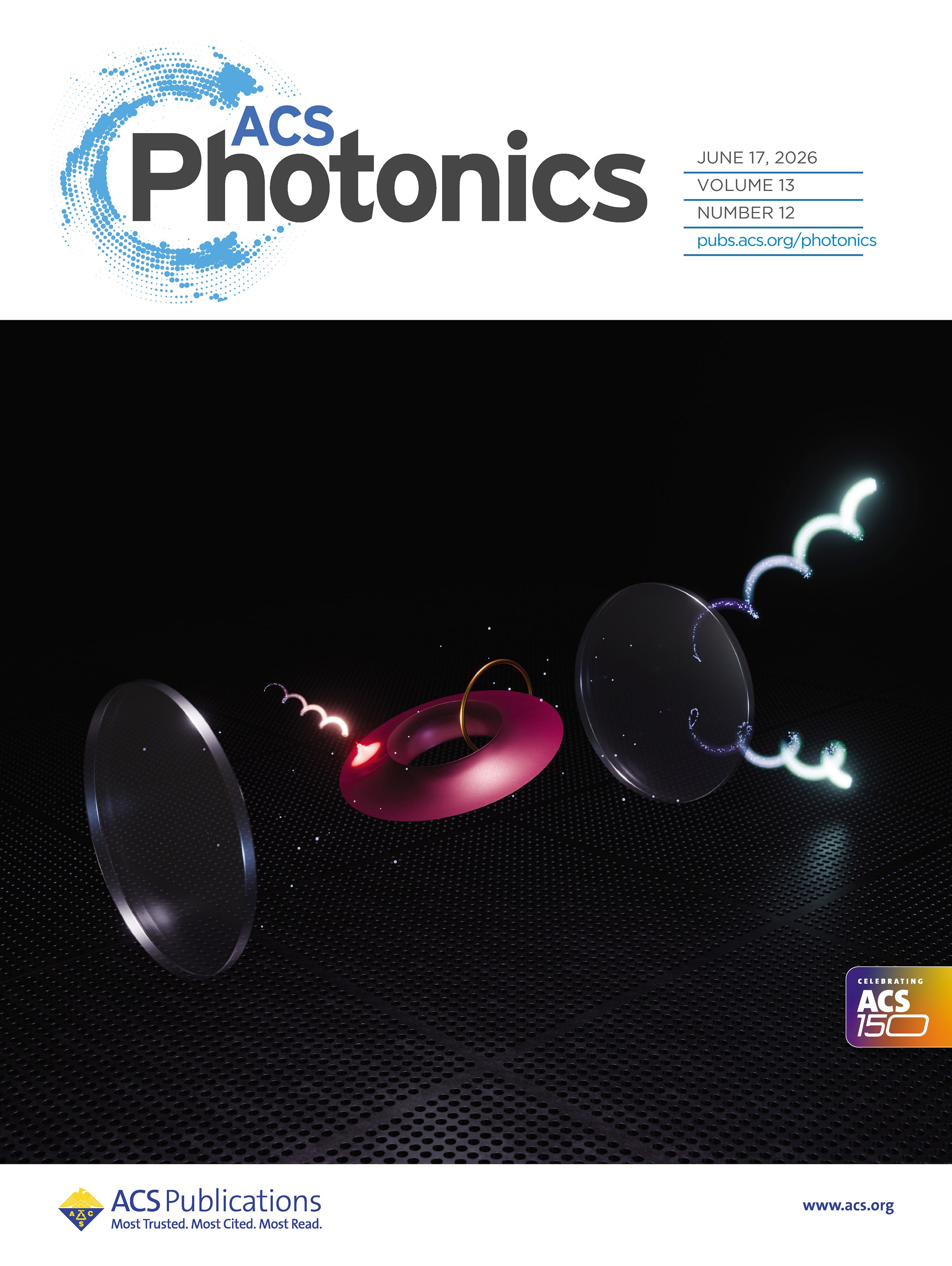
In the second publication from the research groups led by Stefan Schumacher and Jan Sperling, Paderborn-based researchers Jan Wingenbach and Laura Ares, in collaboration with researchers from the University of Arizona, investigated non-Hermitian optical resonators. Here, they were able to detect so-called exceptional rings (ERs). These ring-shaped singularities are characterised by mode merging and distinctive topological properties. The researchers demonstrated that these rings arise through circular dichroism and TE–TM splitting in planar optical resonators. The behaviour of these singularities in non-linear systems had previously remained unexplored. The researchers showed that, upon the addition of Kerr non-linearity, a single ring splits into a closed surface of rings. These topological light states exhibit high sensitivity and are considered promising for future optical sensing and signal processing. The paper can be found at the following link.
Both approaches demonstrate that controlled coupling and structural symmetry breaking can lead to extraordinary eigenstates and highly sensitive optical behaviour.