Paderborn University scientists publish results in Optics Express
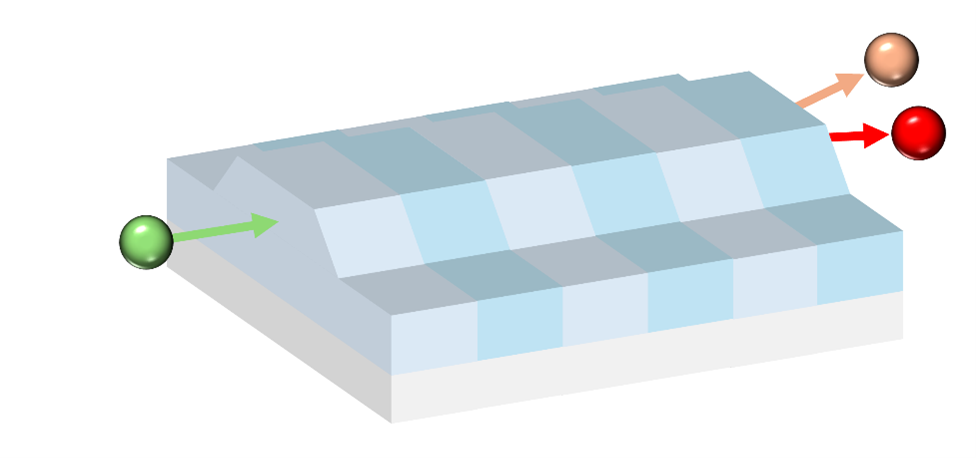
Scientists at Paderborn University have made progress in the field of quantum research: they have demonstrated a light source on a chip made of thin-film lithium niobate that generates photons, small quanta of light, in pairs. The researchers from Prof Dr Christine Silberhorn's "Integrated Quantum Optics" group succeeded in generating two photons with significantly different wavelengths from a green photon in a waveguide. The special thing about this is that the photons have two very different colours: One photon has a wavelength of 815nm (visible) and the other photon of 1550nm (infrared). This combination is particularly suitable for applications in quantum communication or quantum spectroscopy. The results have now been published in the peer-reviewed journal Optics Express.
Photons play a key role in many applications in the field of quantum optics. To generate single photons, the researchers used the quantum mechanical process parametric fluorescence. This process describes how a single high-energy photon is converted into two lower-energy photons in a non-linear crystal. By using waveguides in thin film lithium niobate, the scientists achieved a very efficient and bright source. This source is an important step towards the realisation of quantum networks and photonic quantum computing.
The paper can be accessed here.