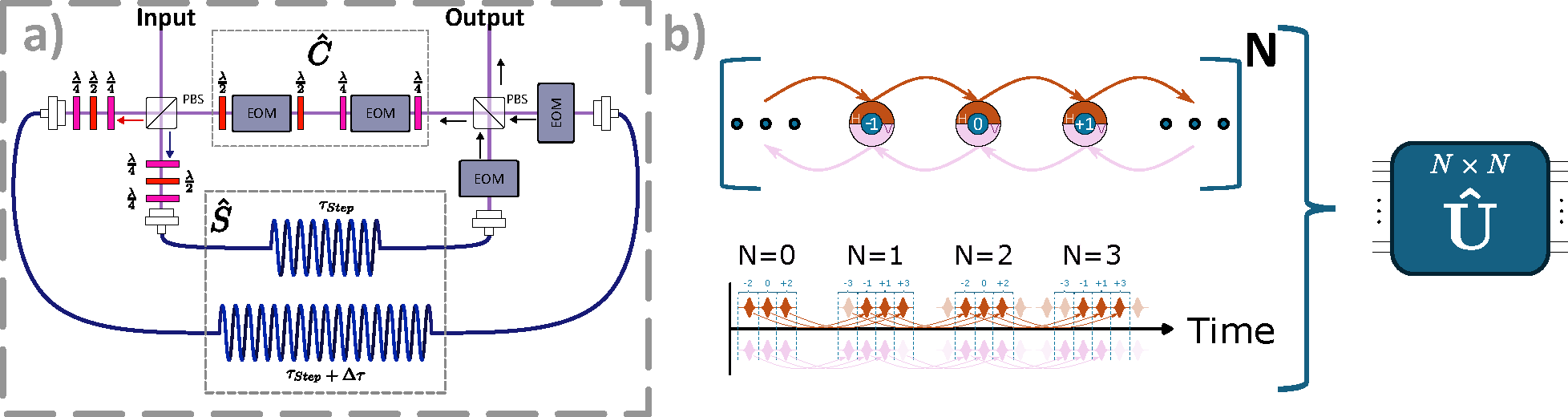
Researchers at the Institute of Photonic Quantum Systems (PhoQS) have published a paper combining experimental and theoretical physics expertise from two research groups: the Integrated Quantum Optics group, led by Christine Silberhorn, and the Theoretical Quantum Science group, led by Jan Sperling. In this collaboration, Jonas Lammers, Laura Ares, and co-authors present a new type of photonic processor for quantum information processing.
Unlike conventional electronic processors, photonic processors utilize light to carry and process information. In optical information processing, information is encoded in so-called optical modes. These modes can be thought of as the different “channels” available to the processor, similar to how bits provide the basic units of information in conventional computing. Importantly, photonic processors can operate at the level of individual photons, the smallest units of light, which makes them suitable for processing quantum information. This makes them one of the most promising platforms for future quantum technologies, as photons can travel with very little disturbance and can be manipulated with high precision.
In recent years, optical processors have already been deployed to demonstrate quantum advantage in specific tasks, such as so-called Gaussian Boson Sampling experiments, which are extremely difficult for conventional computers. However, moving from these proof-of-principle demonstrations towards practical quantum information processing requires optical processors that are scalable, efficient, and robust against noise and imperfections.
Similar to conventional processors, the developed photonic processor consists of a single core unit, which acts on neighbouring optical modes, together with a feedback loop that allows this core unit to be reused many times. This makes it possible to expand the processor to an arbitrarily large number of optical modes without requiring a completely new physical component for every operation. Here, the researchers utilize one of the key strengths of light as an information carrier: light features a variety of options to encode optical modes, such as its color, polarization, or arrival time. The Researchers show that by combining multiple of these encoding options, the photonic processor becomes both uniquely robust against experimental noise and highly scalable.
Furthermore, the researchers show how to program the photonic processor to implement any desired unitary transformation, which represents the basis for any optical information protocol. To do this, they map the operations available in the coreunit onto a sequence of numbers and sort this sequence using a specific procedure from computer science known as the parallel bubble sort algorithm. This act of sorting corresponds to programming the photonic processor and directly tells us which sequence of core operations has to be applied.In total, the researchers introduced a new photonic processor architecture which is universal, highly scalable, and noise resilient at the same time.
This work has received funding from the Horizon Europe project EPIQUE (Grant No. 101135288).
Lammers, J.; et al., “Resource efficient universal photonic processor based on timemultiplexed
hybrid architecture”, Phys. Rev. Applied, 10.1103/x99y-2sms (2026)